Guide
What size e-bike battery do you need?
Published
Note: This page contains affiliate links. If you buy through them we may earn a commission at no extra cost to you. Learn more
In short
Choose a battery by its watt-hours (Wh), which is volts multiplied by amp hours. Multiply your longest regular ride in miles by a cautious 20 Wh per mile, then add a margin of around a quarter for cold weather and battery ageing. A 15-mile hilly round trip suggests around 400 Wh or more; longer rides or fewer chances to charge point to 500 to 700 Wh.
Products for this job
Compare all 5 productsSAMEBIKE XD26-II: 672 Wh, 100 km claimed
Check price on AmazonAffiliate linkSAMEBIKE RS-A01MEN: 540 Wh, 800+ cycles
Check price on AmazonAffiliate linkSAMEBIKE LO26-II: 48 V 14 Ah, 90 to 110 km
Check price on AmazonAffiliate link
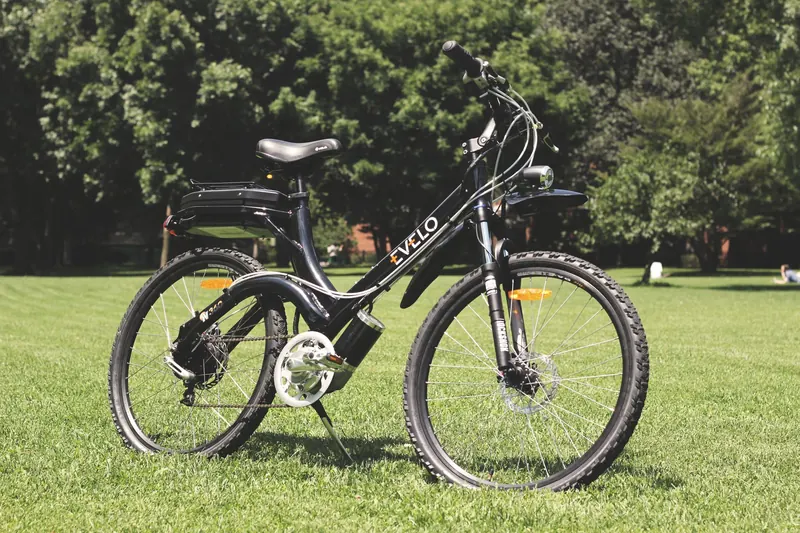
Battery size is one of the main differences between e-bikes, and one of the main reasons for price differences too. Bigger is not always better: a larger pack adds weight and cost, and many riders never use its full capacity. This guide explains how battery capacity is measured, why voltage alone tells you little, and how to match capacity to your own journeys. The same method works whether you are choosing a new bike, a conversion kit or a replacement pack.
Volts, amp hours and watt-hours
Three numbers appear on most battery labels. Voltage (V) is the electrical pressure the system runs at, usually 36 V or 48 V on UK e-bikes. Amp hours (Ah) describe how much charge the pack holds at that voltage. Watt-hours (Wh) combine the two and tell you how much energy is stored: Wh = V x Ah.
Wh is the number to compare. A 36 V 14 Ah battery holds 504 Wh; a 48 V 10 Ah battery holds 480 Wh. Despite the higher voltage, the second holds slightly less energy. Our 36 V vs 48 V guide explains why voltage does not decide power or legality on its own.
- Battery size36 V x 14 Ah= 504 Wh
- Range (54 km)504 Wh ÷ 15 Wh/mile≈ 34 miles
- Cost per full charge504 ÷ 1,000 x 25p= 12.6p
Match the battery to your journeys
Start with your longest regular ride between charges, then estimate how much energy it needs.
| Typical use | Energy needed | Battery size to consider |
|---|---|---|
| 8-mile flat round trip, charge daily | About 120 to 150 Wh | 300 to 400 Wh is plenty |
| 15-mile hilly round trip | About 300 Wh | 400 to 500 Wh |
| 25-mile mixed commute, charge every other day | About 1,000 Wh over two days | Charge at work, or 625 Wh or more |
| Long weekend rides of 40 miles or more | About 800 Wh | 700 Wh plus, or a second battery |
- 1
Note the distance of your longest regular ride between charges, in miles.
- 2
Multiply by a Wh per mile figure: about 12 to 15 for flat, gentle riding, around 20 for hills or higher assist.
- 3
Add about 25% for cold weather, battery ageing and detours.
- 4
Pick a battery with at least that many Wh.
How often can you charge?
If you can charge at home every night or at both ends of your journey, a smaller battery may be enough, and the bike will be lighter and cheaper. If you live in a flat without easy access to a socket near where the bike is kept, or you want to ride several days between charges, a larger pack is more convenient.
Remember that charging should happen while you are around and awake, away from escape routes, using the supplied charger. That may influence how often you can realistically charge.
Note:Lithium battery safety: charge only with the charger supplied for your battery, do not leave it charging unattended or overnight while you sleep, charge away from escape routes such as hallways, and stop using any battery that is swollen, cracked, leaking, very hot or smells odd. See the London Fire Brigade guidance on lithium batteries.
Trade-offs of a bigger battery
A larger battery adds range, but it also adds weight, which matters if you carry the bike up stairs or onto trains. It usually takes longer to charge on the same charger, and it costs more to replace. On a folding bike, a big battery can make the bike much harder to lift.
Some bikes offer a range extender, a second battery that plugs in for long rides. That gives you a lighter bike for daily trips and extra range when you need it.
Which e-bikes have the biggest batteries?
Touring, trekking and some electric mountain bikes tend to carry the largest packs, while folders and lightweight city bikes carry smaller ones to keep weight down. Our long-range e-bike guide focuses on bikes with large batteries, and the replacement battery guide covers packs for bikes and kits you already own.
Whatever the size, the bike must still meet the EAPC rules to be ridden on UK roads: a motor with a continuous rated power of no more than 250 W that stops assisting at 15.5 mph. A bigger battery does not change those limits.
Frequently asked questions
Is a 36 V or 48 V battery better? Neither is better on its own. Use the voltage your motor and controller are designed for, and compare packs by Wh.
How many miles will a 500 Wh battery give? Roughly 25 to 50 miles depending on hills, weight, assist level and weather. Divide 500 by your own Wh per mile for a closer figure.
Can I fit a higher Ah battery to my e-bike? Usually, if voltage, connector and mount match and the controller can handle it. Check the bike maker's guidance first.
Does a bigger battery make an e-bike faster? No. Assistance on a road-legal e-bike still stops at 15.5 mph, whatever the battery size.
What you need
- Check price on AmazonAffiliate link
SAMEBIKE XD26-II: 672 Wh, 180 mm hydraulics
- Check price on AmazonAffiliate link
FEIMOKY HL-4813UK: 48 V 13 Ah, UKCA marked
- Check price on AmazonAffiliate link
Carpat GB1: EN 15194, Shimano hydraulic discs